
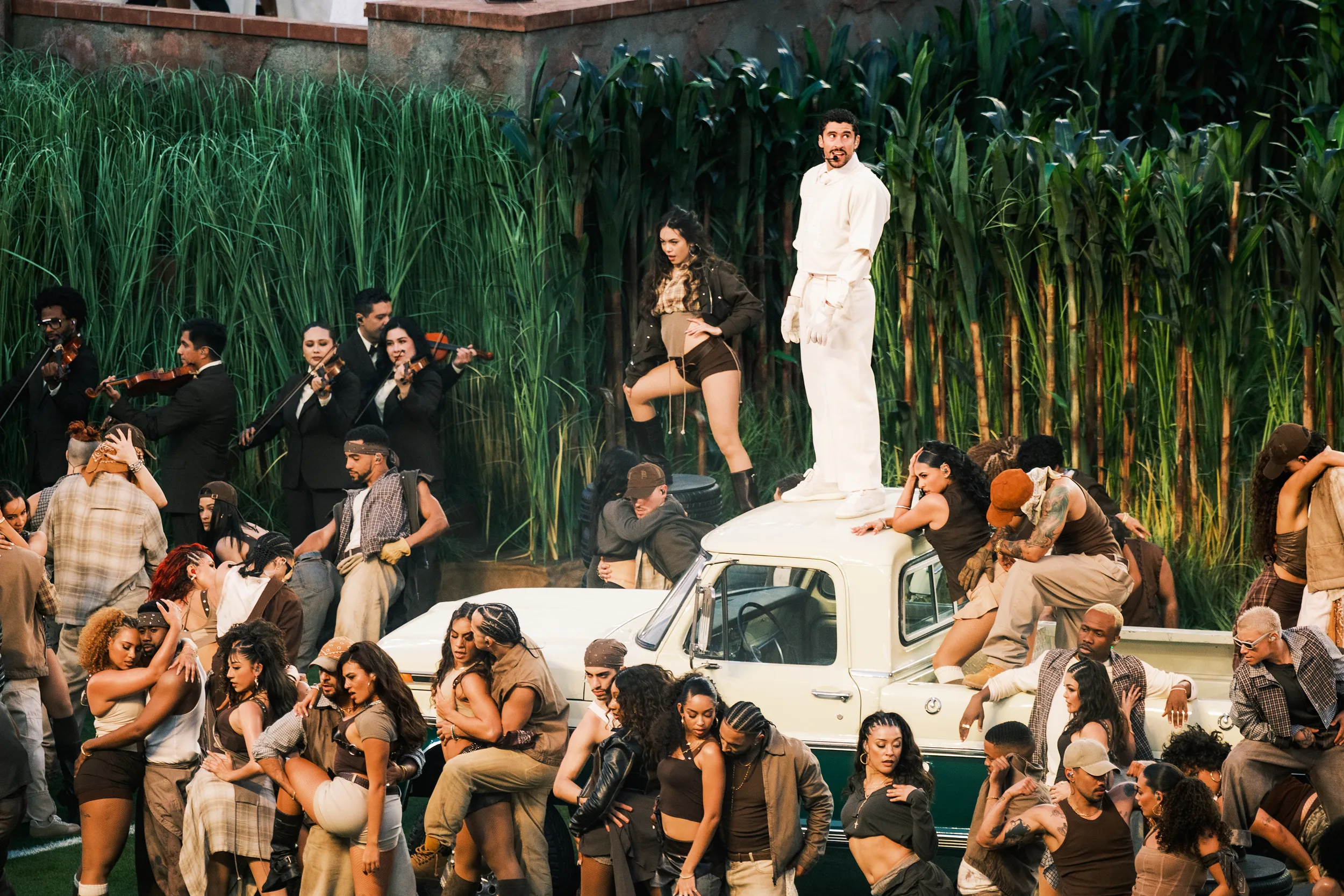
Bad Bunny’s appearance on the Super Bowl stage quickly moved beyond the realm of musical spectacle to become one of the most discussed cultural moments of the year.
On one of the most watched stages in the world, the Puerto Rican artist did more than perform his music. He occupied a space loaded with historical symbolism, bringing with him an identity, a language and cultural references that carry broader social meaning.
By performing predominantly in Spanish, Bad Bunny placed Latin culture at the center of an event that for decades represented a very specific idea of American identity.
This was not incidental. It was a statement.
In a social context shaped by debates around immigration, borders and national identity, seeing the Super Bowl stage filled with Latin rhythms and Spanish language lyrics inevitably assumed cultural significance.
The aesthetics of the performance reinforced that interpretation.
Symbols of unity, references to cultural diversity and moments celebrating Latin identity elevated the show beyond entertainment. For many viewers, it became a powerful gesture of representation. For others, it was perceived as an unnecessary politicization of a sporting event.
The division of opinion revealed something important. Culture and politics rarely operate separately in events of this scale.
The implications extend beyond the controversy itself.
The moment signals a broader transformation in the role of the Super Bowl halftime show. What was once a largely neutral space for pop spectacle has increasingly become a stage for narrative and cultural positioning.
Artists no longer appear there simply to perform.
They appear to communicate.
In Bad Bunny’s case, the message was both simple and powerful. Latin identity is not peripheral to contemporary culture. It is part of its center.
By occupying the stage in his own language and celebrating his cultural references, he expanded the meaning of what can be considered mainstream.
Was it political?
For many observers, yes.
Yet a more revealing question may be another.
In a cultural environment that becomes more diverse and interconnected every year, is it still possible to fully separate entertainment from positioning?
Moments like this suggest that the boundary is becoming increasingly blurred.
The Super Bowl stage is no longer only a platform for spectacle. It has also become a space where culture negotiates identity, visibility and influence.