
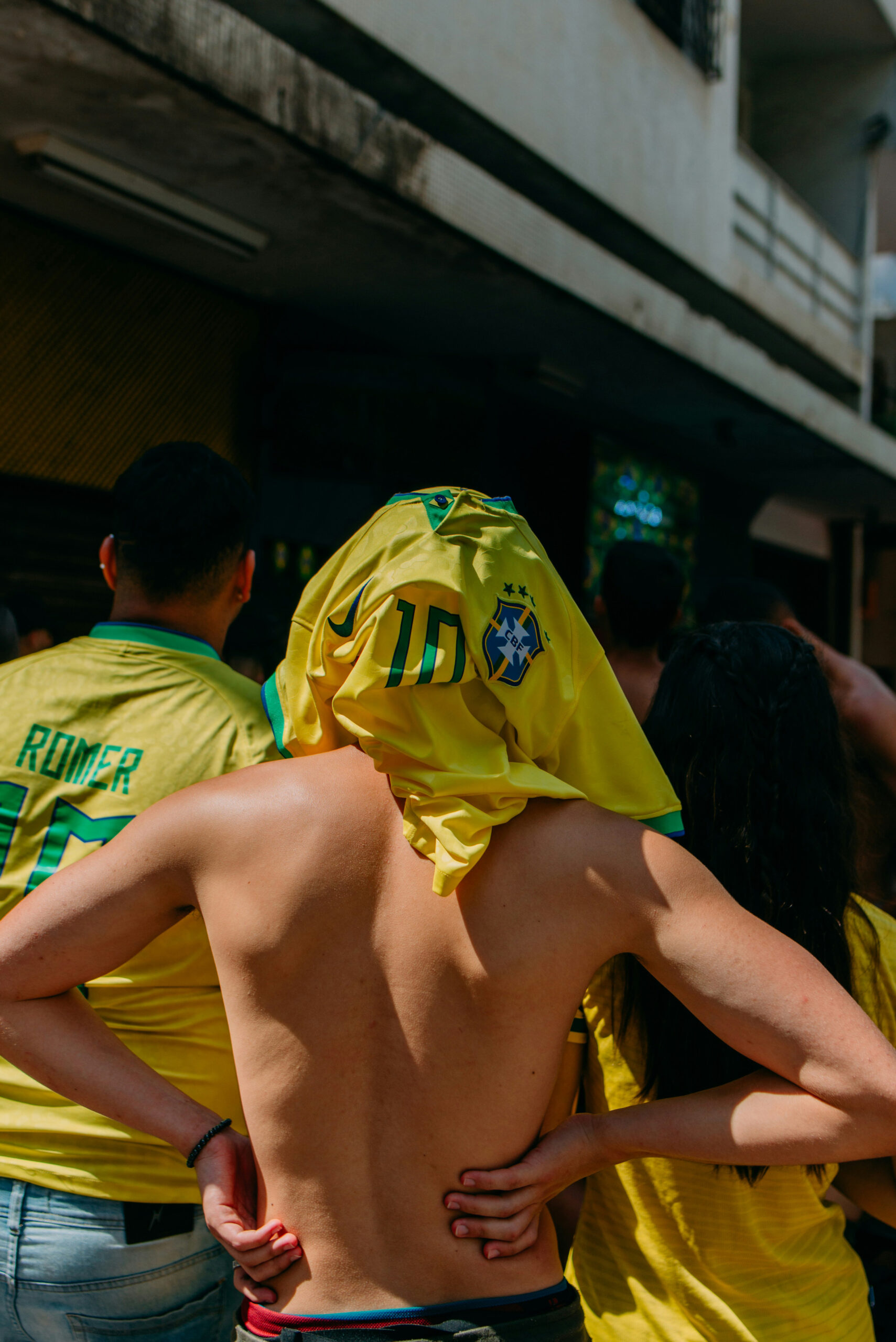
From time to time, the world rediscovers Brazil. Not only as a tourist destination or the country of football, but as an aesthetic, a language and an attitude.
Another of these cycles now appears to be underway. Brazil Core has returned with force, and this time not as a passing fashion detail but as a global cultural phenomenon.
For many analysts, the turning point occurred during the 2022 World Cup in Qatar. At that moment, the national team’s yellow jersey moved beyond the pitch and became an international fashion symbol. Influencers began wearing the shirt as streetwear. Editorials incorporated green and yellow palettes. Brazil emerged as a desirable visual code.
Football once again opened the door to something larger. Brazil as a trend.
Brazil Core did not sustain itself on sporting nostalgia alone. It gained momentum in the following years with the global expansion of Brazilian funk, which began appearing in international playlists, remixes and digital trends. Brazilian artists expanded their presence at festivals, collaborations and across popular culture.
At the same time, objects associated with the Brazilian imaginary began appearing more frequently in the wardrobes of celebrities and creators. Football shirts, tropical colors and beach references moved into the global fashion conversation. Brazil was no longer merely a source of inspiration. It had become a reference point.
Global brands also contributed to amplifying the aesthetic. Vibrant color palettes, sporty silhouettes, sensuality, tropical prints and the idea of an endless summer returned strongly in campaigns and collections.
Brazil Core came to represent a specific kind of energy. Color, body, celebration and freedom. In many ways it functions as a cultural counterpoint to a world increasingly defined by minimalism, anxiety and control.
Within this context the term itself begins to make sense. Brazil Core celebrates Brazilian culture in its most sensory form. Heat, loud music, improvisation, beaches, football, carnival, funk, colorful accessories and a joyful chaos that seems difficult to translate into another language.
On social platforms the aesthetic appears in videos saturated with yellow and green, outfits combining football shirts with urban fashion and imagery filtered through intense sunlight.
What gives this aesthetic its strength is the way it responds to a global appetite for authenticity. As trends become increasingly repetitive, interest grows in cultures that possess territory, history and a tangible identity.
Brazil offers this naturally.
Its culture reflects a living mixture of Indigenous, African, European and peripheral influences. A cultural fabric that cannot be reduced to a single narrative.
There is also an important internal dimension. Elements long dismissed as excessive or overly popular are beginning to be reframed as style. The football shirt becomes fashion. The flip-flop becomes a statement. Heat itself becomes aesthetic.
In that sense Brazil Core is not only an export. It is also a form of reconciliation.
Like any global trend, it raises debate. There is always the risk that a complex culture will be reduced to a tropical caricature. Yet when accompanied by context and respect, the movement reveals something more meaningful.
Brazil has once again become a subject of global conversation. This time it appears not as a stereotype, but as the author of its own language.
Perhaps that is the most accurate definition of Brazil Core.
It is not only fashion. It is not only an internet phenomenon.
It is the world remembering once again that Brazil is not simply a country.
It is an imagination.